
FOCUS® on Eye Health: Why Lutein, Zeaxanthin, Vitamins & DHA Matter for Your Eyes 🌿 100% Vegetarian
Updated: 12 hours ago
Think about how much your eyes do every day.
They help you read emails, scroll through social media, stare at spreadsheets, watch movies, navigate traffic, recognize faces, and somehow still have to deal with the famous "Where did I put my phone?" investigation.
Our eyes are constantly exposed to light and oxidative stress. The retina, particularly the macula, has high metabolic activity and is therefore particularly vulnerable to oxidative processes.
This is where nutrition becomes interesting.
Certain nutrients, including Lutein, Zeaxanthin, Vitamins A, C, and E, and Omega-3 Fatty Acids such as DHA play important biological roles in maintaining normal eye and retinal function.
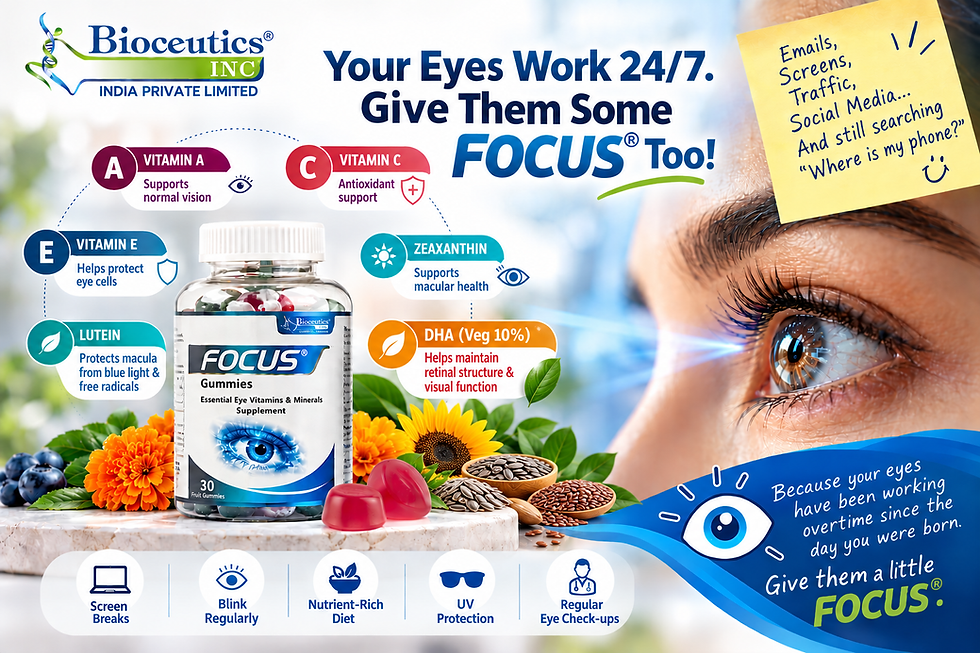
FOCUS® Gummies Essential Eye Vitamins & Minerals Gummies are formulated around several of these nutrients, providing a convenient way to include Eye-supporting Nutrients in a Daily Routine.
But what does the Science Actually say?
Let's take a closer look.
The Science Behind Eye Nutrition
The Eye isn't Simply a Camera.
It is a Highly Specialized Biological System involving the Cornea, Lens, Retina, Photoreceptors, Macula, Optic Nerve and Visual pathways.
And just like every other tissue, the Eye Needs Nutrients to function properly.
Among the Nutrients Attracting Considerable Scientific interest are Lutein, Zeaxanthin and DHA, along with Antioxidant Vitamins.
Lutein is a Carotenoid Naturally Concentrated in the Retina, Particularly in the Macula.
Along with Zeaxanthin and Meso-Zeaxanthin, it forms the Macular Pigment.
Research suggests that these Carotenoids can act as Antioxidants and Absorb certain wavelengths of short-wavelength visible light.
Think of Lutein and Zeaxanthin as part of the eye's own "Optical Security System."
They're not Sunglasses, and your Phone Screen won't politely disappear, but these pigments play an important biological role in the Macula.
A Systematic review and Meta-analysis covering 46 Studies and 3,189 participants found that Lutein/ Zeaxanthin intake increased Macular Pigment Optical Density, Particularly at intakes of 5 mg/ day or Higher.
Why does Macular Pigment Matter?
The Macula Supports Central, Detailed Vision.
Lutein and Zeaxanthin Accumulate there and contribute to the Macular Pigment, which has Antioxidant and Light-filtering properties.
In simple words: Your eyes have their own nutritional VIP section, and Lutein and Zeaxanthin are Two of the Important guests.
Zeaxanthin is another Carotenoid Concentrated in the Macula.
Together, lutein and zeaxanthin are often discussed in relation to:
Macular Pigment
Oxidative Defence
Light Filtering
Visual Function
Retinal Health
Scientific reviews describe Lutein and Zeaxanthin as important macular pigments with antioxidant and short-wavelength light-filtering properties.
This doesn't mean that taking Zeaxanthin gives your Eyes Superhero Vision.
Unfortunately, your phone camera still won't become an X-ray machine.
But these Carotenoids do have a Scientifically Recognised role in Ocular Nutrition.
Vitamin A is Particularly important for Normal Visual Function.
One reason is its involvement in Rhodopsin, a light-Sensitive Pigment required for Vision in low-light conditions.
Severe vitamin A deficiency can cause night Blindness and, in more Advanced Deficiency, serious ocular damage.
So when we talk about vitamin A and vision, we're not talking about marketing magic.
We're talking about basic visual biology.
The important distinction
Adequate vitamin A is essential for normal vision.
However, that doesn't mean that taking extra vitamin A automatically improves eyesight beyond normal physiological function.
More isn't always more, especially with fat-soluble vitamins.
Vitamin C is a water-soluble vitamin and an important physiological antioxidant.
It also participates in collagen synthesis and can help regenerate other antioxidants, including vitamin E.
Why is antioxidant activity relevant to the eye?
The retina has high metabolic activity and is exposed to oxidative stress. Consequently, antioxidant nutrients have attracted considerable interest in eye-health research.
Vitamin C is therefore an important part of overall nutritional support.
But again, let's keep the science honest:
Vitamin C supports normal biological antioxidant functions; it should not be presented as a guaranteed treatment or cure for eye disease.
Vitamin E is a fat-soluble antioxidant that helps protect cells from oxidative damage.
This becomes particularly interesting when we look at the landmark AREDS research.
In the original AREDS trial, a combination containing vitamin C, vitamin E, beta-carotene, zinc, and copper reduced the risk of progression to advanced age-related macular degeneration (AMD) in people with certain stages of AMD.
However, there's an important point:
AREDS/AREDS2 is a specific high-dose formulation studied in people with AMD not evidence that every eye supplement prevents AMD.
The National Eye Institute specifically notes that AREDS/ AREDS2 supplements don't prevent AMD from developing and are primarily relevant to people with intermediate or certain forms of advanced AMD.
That's an important distinction between supporting eye nutrition and treating an eye disease.
DHA, or Docosahexaenoic Acid, is an Omega-3 Fatty Acid with an important Structural Role in the Retina.
Research has highlighted the high concentration and active conservation of DHA within retinal tissue, particularly in Photoreceptor membranes.
Other reviews describe omega-3 fatty acids as important components of photoreceptor membranes and discuss their potential roles in retinal function and oxidative processes.
So when you see DHA associated with eye nutrition, there is a biological reason behind it.
But here's the scientific reality:
The presence of DHA in the retina doesn't automatically mean that DHA supplementation prevents every eye disease.
For example, the large AREDS2 randomized trial found that adding DHA + EPA to the AREDS formulation did not significantly reduce progression to advanced AMD in its primary analysis.
That's why good scientific communication matters.
DHA has an important biological role in the retina but supplementation claims should stay within the evidence.
"Can These Nutrients Prevent Cataracts or AMD?"
This is where we need to separate nutrition science from advertising myths.
The AREDS and AREDS2 trials studied whether nutritional supplements could prevent or slow AMD and cataract.
The National Eye Institute reports that AREDS/ AREDS2 supplements can reduce progression from intermediate to advanced AMD by about 25%, but they do not prevent AMD from developing and did not show an effect on cataract.
Similarly, the original AREDS2 randomized trial found no significant overall additional reduction in advanced AMD progression from adding lutein + zeaxanthin or omega-3 fatty acids to the AREDS formulation.
Interestingly, subsequent analyses found evidence supporting lutein/zeaxanthin as a replacement for beta-carotene in AREDS-type formulations, particularly because beta-carotene carries a lung-cancer risk for current or former smokers.
What About Screens?
Here's the funny part.
Your eyes don't know whether you're looking at:
A medical journal or a 47-minute Instagram Reel spiral at 1:17 AM ...?
They just know they're looking.
Lutein and zeaxanthin are biologically involved in the macular pigment and have light-filtering and antioxidant properties.
However, nutritional supplements should not be described as protection against all screen-related eye problems.
If you spend long hours in front of a screen, basic eye-care habits still matter:
Follow the 20-20-20 rule.
Blink regularly.
Maintain appropriate screen distance.
Adjust screen brightness and room lighting.
Get adequate sleep.
Have regular eye examinations when appropriate.
And yes, occasionally looking away from the screen is still legal.
Why FOCUS® Gummies?
Because healthy habits are easier to maintain when they're convenient.
FOCUS® Essential Eye Vitamins & Minerals Gummies bring together Key Nutrients Associated with eye and Retinal Health in an Easy-to-use Gummy Format.
Your eyes have been working since the day you were born.
Maybe it's time to give them a little FOCUS®.
Comments