
Can Capsaicin Kill Melanoma Cells? Exploring Apoptosis, Autophagy & Cancer Research
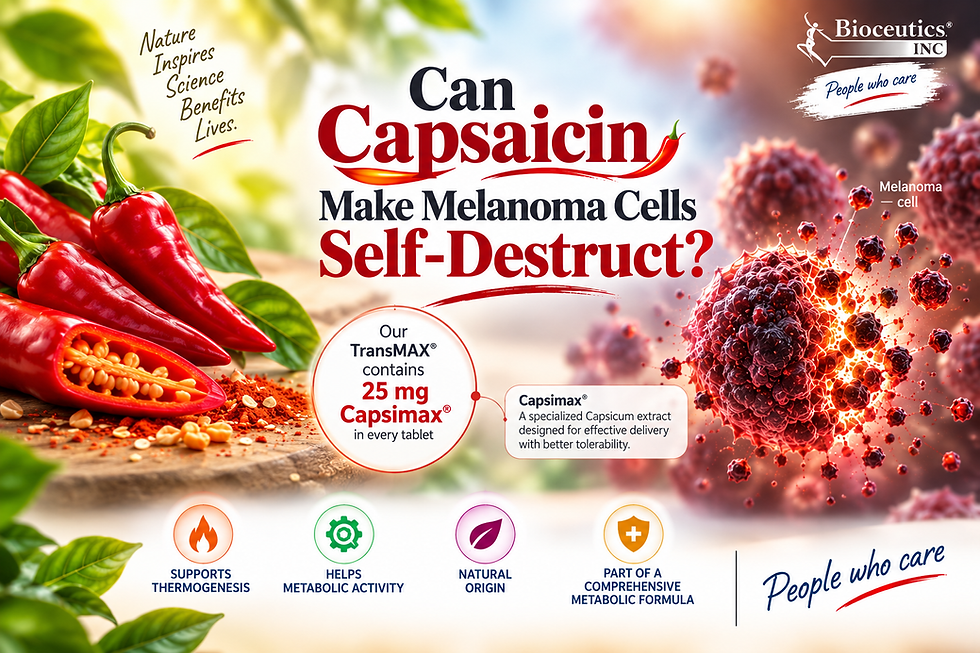
Last week, while scrolling through LinkedIn, my eyes caught an interesting post.
The headline was intriguing:
“Can Capsaicin Make Melanoma Cells Self-Destruct?”
I paused.
Capsaicin?
The same compound we know for giving chilli peppers their unmistakable heat?
I had always associated capsaicin with chilli, thermogenesis, and metabolism. But the possibility that researchers were investigating its effects on melanoma cells was something I had to look into.
And the science turned out to be much more interesting than the headline suggested.
Capsaicin is the pungent component responsible for the characteristic heat of chilly peppers.
But biologically, it is much more than just a molecule that makes food spicy.
Researchers have investigated capsaicin's effects on several cellular pathways, including processes involved in cell proliferation, oxidative stress, apoptosis and autophagy.
And melanoma became one of the areas of interest.
A 2019 study published in Oncology Letters investigated capsaicin in human melanoma cell lines A375 and C8161.
The researchers observed that capsaicin treatment reduced melanoma-cell viability and increased markers associated with apoptosis, including activation of caspase-3 and PARP cleavage. They also observed autophagy-related changes.
That sounds remarkable.
But there is an important question:
What exactly does “self-destruct” mean at the cellular level?
One defining feature of cancer cells is their ability to escape the normal mechanisms that control cell survival and proliferation.
Apoptosis is one of the body's programmed cell-death mechanisms.
Think of it as a cellular “controlled shutdown.”
When apoptosis is appropriately activated, a damaged or unwanted cell can undergo an organized process of death rather than continuing to multiply.
In the 2019 melanoma study, capsaicin increased apoptotic markers in the melanoma cells studied, including cleaved caspase-3 and cleaved PARP.
But the story doesn't stop there.
The researchers also observed activation of autophagy.
Autophagy is often described as a cellular “recycling system”; cells break down and recycle damaged or unnecessary components.
Interestingly, autophagy doesn't always mean that a cancer cell immediately dies.
In the 2019 study, inhibiting autophagy actually increased capsaicin-associated apoptosis in the melanoma cells. This suggested that, under those experimental conditions, the autophagy response could act partly as a survival mechanism for the cells.
So the biology is more complicated than:
Capsaicin → cancer cell → instant destruction.
The real story is about cellular signalling and the balance between survival and death pathways.
And that's where another fascinating study comes in.
In a 2021 study published in the American Journal of Cancer Research, researchers investigated another mechanism through which capsaicin affected melanoma cells.
They reported that capsaicin targeted tNOX, a protein associated with cellular growth and redox regulation.
The researchers found that inhibition of the tNOX–SIRT1 axis was associated with increased oxidative stress and ROS-dependent autophagy in melanoma cells.
They also reported suppression of melanoma tumour growth in mouse models.
BUT DOES THIS MEAN CHILLI CAN CURE CANCER ?
NO!
And this is perhaps the most important part of the story.
The findings are preclinical.
The studies involved laboratory melanoma cells and, in the 2021 research, animal models. They do not establish that eating chilly, consuming capsaicin, or taking a capsaicinoid supplement can treat melanoma in humans.
So the headline:
“Can Capsaicin Make Melanoma Cells Self-Destruct?”
is an intriguing way to start the conversation.
But the scientifically responsible conclusion is:
Capsaicin has demonstrated interesting anticancer mechanisms in preclinical melanoma research, but much more research is required before these findings can translate into a human cancer treatment.
That's where good science matters.
"So why did this research catch my attention even more?"
Because Capsaicinoids also have a place in metabolic research.
And this is where we look at one of the ingredients incorporated into TransMAX®.
25 mg of Capsimax®
Capsimax® is a specialized Capsicum extract designed to deliver capsaicinoids while addressing the intense burning sensation traditionally associated with chilli extracts.
For TransMAX®,Capsimax® isn't positioned as a cancer treatment.
Instead, it serves as a vital component of a comprehensive metabolic support formulation, with ingredients specifically selected for their synergistic effects on effective metabolic management.


Comments